


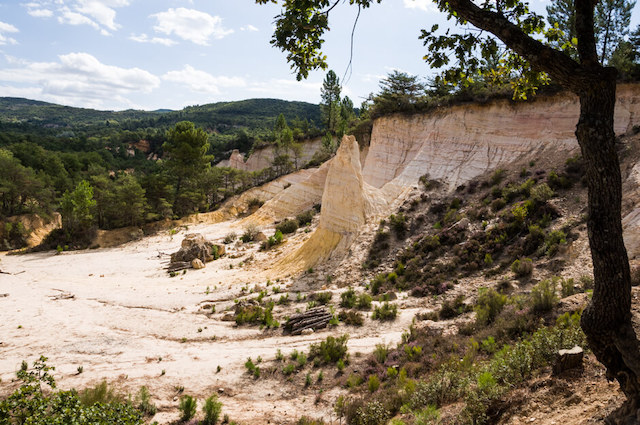
The very small village of Rustrel is located against the Plateau d'Albion in the Parc Naturel Régional du Luberon. This short walk goes through the famous old ocher quarries and mines. It is enjoying the beautiful color palette with countless shades of orange, flaming red, yellow and purple, hence the name Colorado Provençal de Rustrel. The ocher earth is the result of sand deposits created by the withdrawal of the sea millions of years ago.
Distance: 6 km.
Time: 2h00.
Grade: Easy.
Type: Circular.
Gps Track: Yes.
Route description: No.
Wheelchair: Not suitable.
Dog: Allowed.
Height gain: 130 meters.
Trail: 100% unpaved.
Marking: Orange dash and GR6.
Hiking shoes recommended.
Advertisement.
Barriès.
From the parking lot, you first follow a dirt road and pass a drainage canal. From there, you head towards the spectacular ochre-colored rock formations. It's like walking through the Sahara Desert. The path climbs, and once you reach the highest point, you'll be rewarded with a magnificent view of this remarkable place. Just before leaving the area, it's worth following the GR6 out and back to the Barriès viewpoint. Like the rest of the area, this site is also a former ochre quarry, but it offers stunning panoramic views. It's sometimes referred to as the "Cirque de Barriès."
There is a shorter route of 2 km marked by a blue line.
Site closed in January.
POI 1 - Le Colorado Provençal.
The region around Roussillon, Gargas, Villars, Gignac and Rustrel is famous for its wealth of ochres, yellow and red dyes extracted from ferrous clay. The large ocher quarries in Roussillon were operated since the end of the 18th century. Until 1930, thousands of people found work here. Today it is forbidden to dig ocher. This prohibition was introduced to prevent the entire site from being excavated and thus disappearing. As the demand for dyes for textiles increased in the 18th century, the exploitation of ocher increased. An example of such a company is the former ocher factory Mathieu, which is now set up as a 'Conservatoire': a workplace with a museum function. In the 20th century, more modern mining techniques enabled the exploitation of other, more profitable mines. This ensured that all mines in the Roussillon area were gradually closed. Since the early 1980s, tourism has replaced the mining industry.
Pays d'Apt Luberon.
www.luberon-apt.fr


